History of Design
Final Paper
The Model as Muse at the Metropolitan Museum of Art
As seen through the eyes of Thorstein Veblen
In a time when wastefulness is at an all time high, a time when men, women and even children live on the ever-moving conveyor belt of of consumption the Metropolitan Museum of Art has decided to exhibit a show celebrating the worship of retail culture. While “the Model as Muse,” as the exhibit is titled focuses on the rise to prominence of those wearing the garments one cannot help but to mention that their entire profession serves solely to promote the capitalistic gains of the design house.
The show begins in 1947, a crossroads for history and fashion in many respects. One, the Post-WWII yearnings of consumers, especially those living in America, made them hungry for a new ostentatious style after the trauma and rationing that accompanied the war. Two, Christian Dior debuted “the New Look,” an ultra-feminine mode of dress designed to exaggerate hips and bust while cinching in the waist but always emphasizing the lady as demure and refined.
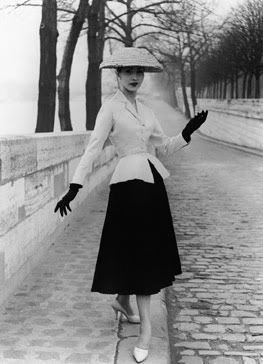
Dior’s New Look circa 1951
Three, the Ford modeling Agency, now one of the foremost businesses of its kind, opened its doors.
Almost immediately one can see the idea of “hemline economics” at play in this chronological show. While some swear it is an actual market barometer rather than a coincidence or after effect, it has been noted that within the last century the length of skirt hemlines has often reflected not just the cultural climate of an era but also the severity of the economic forecast. This is reflected in flapper fashion of the 20’s to the more austere slim, straight silhouette of the 30’s. Similarly, the New Look amplifies the female form and brought the skirt up slightly, optimistically after WWII and was immediately followed by the mini skirt craze of the free-wheeling and design conscious 60’s, which is shown in the exhibition in works designed by Paco Rabanne, Yves Saint Laurent and others.

Donyale Luna in Paco Rabbane photo by Richard Avedon

Twiggy in Yves Saint Laurent dress 1967
The idea of fashion is rooted therefore not in the spirit of creativity, change of joie de vivre but truly in the lifestyle of happiness sought through planned obsolescence, the very vehicle through which countries have been padding their economies for decades. Hemlines, shoulder pads, ribbons, bows, and buttons all are ornamented constructed within an inch of usability and then deconstructed once more. The result amounts to little more than the use of motion lines which have trickled down from automobile design to produce the women’s first streamlined, aerodynamic toaster. This calls to mind the photo print of a design for a topless bathing suit designed by Rudi Gernriech which is included in the show. As modeled by Peggy Moffitt in 1964 the design caused a stir not just because of its originality but truly because of the futility of such a design; a piece of clothing which is not wearable or usable for the task for which it is designed. Thus my own point on the matter of beauty and value is once more upheld.

Peggy Moffitt in topless swimsuit by Rudi Gernreich 1964
A consumer looks not for utility and ergonomics in a design for a kitchen tool, or warmth and quality of fabric in a garment but for sheer aesthetics. Aesthetics which change in the modern era as quickly as the wind; blowing sense and frugality out of a buyer’s mind and occupying a person with only the fantasy of what that object will make their life seem like and which neighbors will admire enough to go out and emulate themselves. Fashion at some point long before the time frame this exhibit is set in took a turn for the absurd, expensive and mercurial and has never quite come back to being practical for more than a hiccup in collective culture, as witnessed by the Great Depression/ WWII era and the recession during the 1970’s. Each period stands in contrast to their subsequent eras of the 50’s and 80’s respectively when fashion once more became “artistic” and consumed with the idea of the designer. Two of the Met’s photos which explore this idea are the 1972 photo of the more practical designs of Halston and his Halstonettes
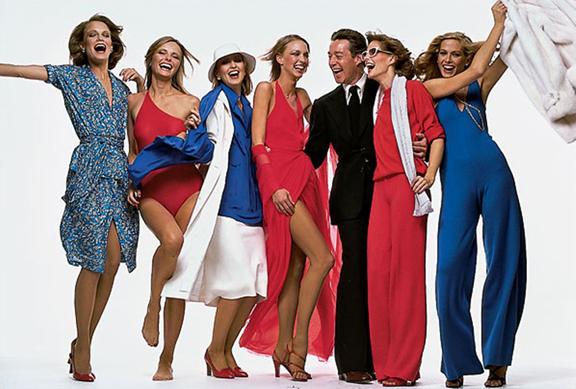
Halston and the Halstonettes
versus a 1985 photo of Iman modeling Thierry Mugler in which she wears a silver lame dress with breasts exposed save for giant mirror pasties and earrings the size of saucers. While the Halstonettes could easily be well-dressed working women on the go Iman is set into a fantasy; a world in which clothing is as unusable and impossible as can be. One in which the consumer is not worried about the viability of prêt-a-porter fashion versus the dream world of haute couture editorials and wants that fantasy for themselves.
One understands the true meaning of fashion rather than clothing when perusing the haute couture offerings within the galleries of the show. It is wearable art for art’s sake and is often wild, outlandish and often nearly unwearable. It is “wearable” art for art’s sake. Among these pieces is a green dress with every inch sequined, adorned, and embroidered with stylized covers of Vogue magazine which seems a bit self-indulgent considering the heavy amount of influence Vogue America editor Anna Wintour had on the show. The garment’s heavy sequin construction and long floppy feel make the garment seem grave and would make the wearer feel as if she were dragging it around, least of all problems would be the eventuality that the sequins would quickly begin to fall off with any regular use. Similarly Yves Saint Laurent’s iconic “Mondrian day dress” from 1965 pierces the wall between reality and the new art Mondrian sought to create with De Stijl.
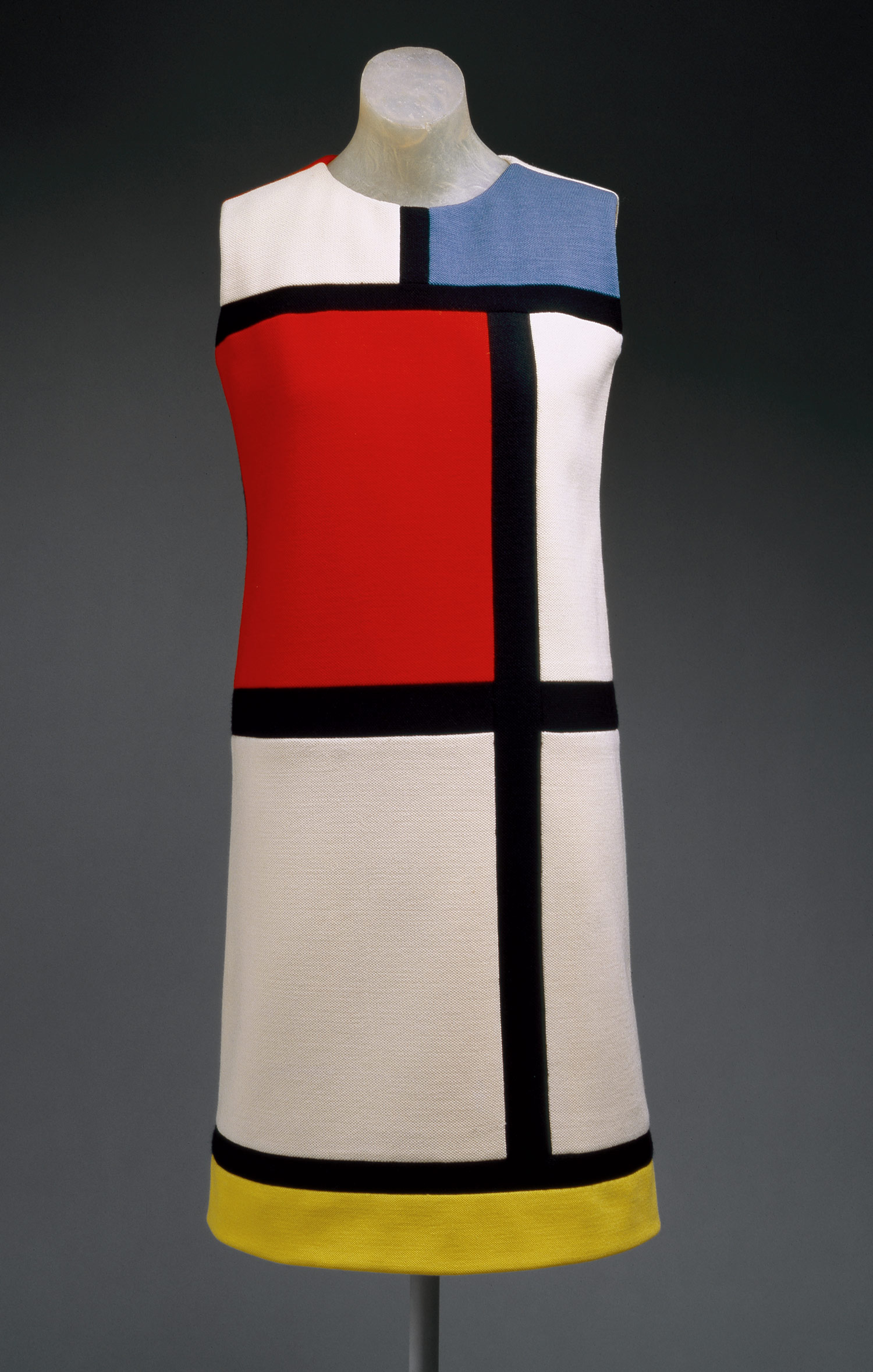
"Mondrian" day dress Yves Saint Laurent 1965
Mondrian wanted a new art for a new universal method of painting and one has to wonder what he would think of his method of painting which was formulated with the idea of uniting all the people of the world under modernism translated to an extremely expensive and festishized form of clothing production like haute couture.
Speaking of practicality of form and intent an interesting line is crossed somewhere within the timeline of this exhibit. Photos stop being just pretty pictures of personified hangers wearing the clothes to be sold and start to be considered for artistic merit. Similarly the photographers taking the pictures were able to build careers as their notoriety grew. Photographers like Richard Avedon, Irving Penn and Peter Lindbergh, who are all featured in the show became influential not only behind the lens but in determining who would wear the clothes being showcased, therefore determining who most well-known faces and names were in the fashion industry. Collectively these three men are associated with approximately eighty years in the fashion industry and in their overlapping careers effected, changed and molded perhaps dozens of “new” “modern” styles into ready-to-consume packages to be emulated by the public at large. Even as their own models or muses became attached and defined by one style and aged, falling out of favor, these photographers could mold and change the new look for the modern woman, enjoying careers that lasted several decades.
As for the relationship between the model and photographer, and designer exhibition co-curator Kohle Yohannen points to two quotes which perfectly crystallize the journey of the model from a breathing mannequin to a supermodel. In 1920 Paul Poiret, one of the leading French designers who specialized in the “new” “modern” uncorseted look for women said to a journalist who attempted to talk to a model during a showing “Do not talk to the girls, they are not here.” Seventy years later supermodel Linda Evangelista spoke for herself saying on the subject of a model’s salary in 1990 “We don’t get out of bed for less than $10,000 a day.” The idea of the model as a career or identity has its legs in the early 20th century. In the same year the exhibition uses as its starting point Irving Penn took a photo he called “The Twelve Most Photographed Models” showing the 12 women all in one room, posing, wearing different modes of dress, all playing the prima ballerina in their own production, seemingly oblivious to the eleven others.
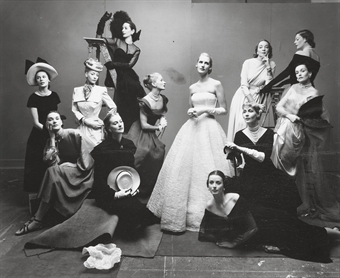
“Twelve Most Photographed Models” Irving Penn 1947
While these women were by no means considered the “supermodels” of the late 80’s and early 90’s this photo charts an interesting change in not only the visibility of a model but also her personal presence. While this cannot be used as a real argument for the case of the fashion industry reflecting any sort of women’s liberation leanings one fact does become clear: from this point on the idea of the single model as a personality or brand and the inception of the spokesmodel is reliant on the idea of the model having a name and being recognized as one person and no one else, thereby asserting her own individuality if not from men then definitely from under the thumb of the designers and photographers, who up to this point controlled a model’s career. This becomes all the more clear in the 80’s when the aforementioned supermodels, Evangelista among them were at the center of an all-out bidding war among the major designers and were regularly offered large sums of money under the table to represent designers exclusively and refuse all other offers.
The Metropolitan Museum of Art’s show features more than just the trivial history of clothes worn by women in the last century. It gives the viewer an almost Marxist understanding of concepts, changes and politics within the fashion industry which is, as many often forget, a business first and foremost. Through the stories of designers, photographers and models detailed throughout the show this becomes ever apparent. From the reactionary Post-WWII fashion of the show’s beginning in 1947 through the rollercoaster of hemline economics to the “greed is good mentality” of supermodels working for the highest bidder in the 80’s the idea of fashion is rooted far more firmly in the frivolity of planned obsolescence than creativity or its true purpose for the human race: the responsibility of making durable, comfortable, equitable clothing for the masses.


No comments:
Post a Comment