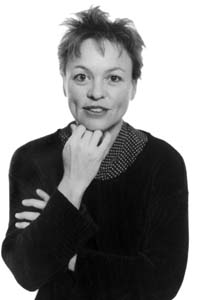
Laurie Anderson is an unusual character in the art world, especially for someone of her generation. She has cornered the market by cultivating a commodity so unique the art word cannot substitute it: herself. Anderson brings to each performance not only a brash enthusiasm but technological savvy and sociological curiosity. She is the old plus the new; a student of human behavior and how it is shaped by technology and also a creator of many new technological feats and devices. She is unquestionably a superstar of the modern art and new media world whose gender never seems to enter the picture as a problem and is instead only a facet of her work. Her singular take on art and pop culture over the years has gained her fame, distinction and a number two hit on the British pop charts. Beyond these novelties she also has a gift for understanding the temporalities and possibilities of performance art and exploits them not only to prove whatever thesis she is exploring but also to show viewers exactly how broad the definition of such an art form can be.
Laurie Phillips Anderson was born in 1947 in Glen Ellyn, Illinois. As a child she had a love for the violin, which she began playing at the age of five. Her parents encouraged her passion and she went on to play in the Chicago Youth Symphony. She graduated from Barnard College with high honors and a degree in Art History. In 1972 she received her Masters in Fine Arts in sculpture from Columbia University. She worked several arts related jobs, including as an instructor, a writer for Artforum and illustrating children’s books.
Some of her earliest experiments including sound were completed while she was still pursuing her degree, like a 1969 piece of music composed for car horns. Many of her early recordings survive today only through written records of her own and of people who experienced them as part of art installations during the early 70’s.
One excellent example of Anderson’s grasp of the fragile temporality is her performance piece Duets on Ice. For this composition Anderson played the violin, an instrument which has long been a fixture of her performances on the street while wearing ice skates each embedded into a block of ice. The performance only lasted as long as the ice did and when it melted she would pack up and leave, no matter how big a crowd she had drawn.
 During the 70’s Anderson performed this several times in New York and later in cities around the world as she traveled during much of her early adulthood. Her wanderlust and sense of adventure took her across the U.S. and Europe where the piece made her a bit of a roadside oddity as she performed for passersby. It is one of her most infamous pieces and Anderson would later explain she didn’t mind being the center of attention in her work saying “One of my jobs as an artist is to make contact with the audience and it has to be immediate. They don’t come back later to look at the details in the background.”
Anderson not only understands the nebulous definition of what is and is not performance art but also legitimizes it through the steps she takes in creating her pieces. Her use of the violin, considered not only a respected but highly classical instrument, in her avant garde work stretches what new media means at the same time that it gives her a frame of reference familiar to all viewers to work from. Of the violin Anderson has said “For me, the violin is the perfect alter ego, it’s the instrument closest to the human voice, the female human voice, it’s a siren.” Anderson crafts each piece using the violin into a siren song, evoking human emotion, humor and underscoring important themes within pieces both with the sound of her violin and the relationship between musician and instrument she toys with while playing.
She plays the violin in a capacity which is both classical and ground breaking. For more than 20 years she has worked with audio engineers and designers and has created and collaborated on several landmark inventions that use the violin as a base. A most basic example of this would include a violin that remotely accesses and plays back samples. Anderson extrapolated this idea of how sound is produced, recorded and played back in many different ways and came up with other transmutations of the same idea. The Neon Violin and Bow was used during her Home of the Brave concert series and not only glowed (allowing her to be partially seen and keep the violin at the center of attention even when lights were turned out) but the elements used to light the instrument effected the tone and quality of the violin, producing an ominous buzzing that added to the technophobia and military industrial overtones of the piece. It also had the funny habit of picking up CB radios in the area.
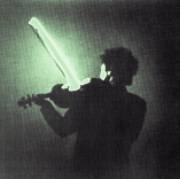
Her Self-Playing Violins play a recording from within them, allowing for the performer to ostensibly play a duet with oneself. She focused on a more ubiquitous format in creating the Viophonograph, which she produced by attaching mini records to her violin and using her bow as a needle. Perhaps her most revolutionary endeavor was her “Tape Bow,” a violin bow that used audio tape instead of horse hair and had a magnetic tape head attached at the top. While this limited the sound she was able to produce in a more confining way, as only one recording was able to be played from each tape bow, Anderson was basically working with an extremely primitive synthesizer (another instrument she uses heavily in her work) as she could use any sound that could be recorded. For this Anderson picked anything from a familiar melody to animal sounds for a sample. She would also record colloquial sayings in other languages, play and record them backwards and then search for meaning in those new recordings, some of which were eventually turned into tape bows. Each bow was labeled so she could pick a sample at will. To this end it seems as though Anderson has achieved one of her goals as she was at one point quoted as saying “I’ve spent a lot of time trying to teach the violin to talk. I love the violin because it’s a romantic, nineteenth-century instrument, and because you can hold it.”
There is a certain turning point reached in Anderson’s work that is exemplified by her choice of musical instruments. She has worked faithfully with the violin for most of her career but also relied heavily on the synthesizer during much of the 80’s. This marks a point of interest and a theme in Anderson’s work: the familiar, romantic, domestic vs., the foreign, cold and technological. The old vs. the new. The warm tone and human voice of the violin, as Anderson noted, is aligned with the old world, classical music and antiquity; a link to a shared past many mainstream Americans cannot tap into or feel connected to. By contrast synthesizers can have a cold, canned sort of sound and are entirely the product of technological innovated, rely inherently on the use of electricity, and some do not require any human touch whatsoever. Their newness, novelty and use in popular culture (most notably rap and pop music) make them immediately accessible to the public and are heard at this point universally on the radio. That being said, Anderson’s two most favorite instruments are directly at odds with one another in sound, method of play and personality. Perhaps this is why both work so well when combined within her work.
Her work at times becomes an all-out rock concert, and few have achieved the sort of rock star status Anderson carries off easily in performances like 1984’s Home of the Brave, a full scale concert which lasted eight hours over the course of two nights. Anderson was backed by a band and played the piano, synthesizer and violin. She had an effortless confidence and grace while exuding an obvious sense that she was at ease with the heavy load of performance material, both the musically and artistically. The use of musical and storytelling elements of Home of the Brave was not unlike those of the Talking Head’s concert film from the same year, Stop Making Sense. Both feature art of a performance and visual nature melded into concert form and Anderson has often been called a female version of Talking Heads front man David Byrne.
Indeed the penchant for suits and high-brow theatrics seem to be a trait shared by both Anderson and Byrne but for Anderson it proves another point. Her use of androgynous suits, her short haircut and tennis shoes worn on stage defies the classical female stereotype even as she seems to reinforce it; she also wears a slinky evening gown and opera length gloves on stage during Home of the Brave but pairs it with those same tennis shoes.
Speaking of rock star status, Anderson has also had the strange distinction of actually being one as she scored a number 2 hit other British pop charts for her song “O Superman,” a song and accompanying video based on the opera Le Cid. She changed the lyrics and themes of the song to reflect the U.S. military industrial complex and the distance that exists between human beings- an alienation that is aided by ever evolving technology. She modifies the opening lyrics singing “O Superman, O juge, o mom and dad,” playing with the original text but also emphasizing the idea of the nuclear family (as a united and as a separated loose network) within the age of nuclear weaponry. As the song comes to a close she intones quietly, half speaking “'Cause when love is gone, there's always justice. And when justice is gone, there's always force. And when force is gone, there's always Mom. Hi, Mom!” This references several different ideas, including the U.S. military as enforcer of “good” in the world, ideals of that American identity (such as truth, love and freedom), and forced or farcical tropes such as the out of place “Hi, Mom!” Anderson further toys with the idea of familial attachment and Cold War sentimentality with the lines “So hold me, Mom, in your long arms. In your automatic arms. Your electronic arms. In your arms. So hold me, Mom, in your long arms. Your petrochemical arms. Your military arms. In your electronic arms.” As these lines fade at the end of the piece her synthesizer swells, the sound of strings is heard and birds chirp in the background anachronistically. The viewer is left stunned, in shock at the gravity of the themes expressed and unfulfilled as Anderson offers no solutions to the problems highlighted.
O, Superman
She has therefore done what many others, including Joseph Beuys have attempted to do unsuccessfully; she has crossed over from the avant garde to the mainstream and in doing so united both high and low art (pop music).
Though Anderson is not seen as being extremely feministic in her work this does not protect her from the slings and arrows of some of her more gender-political colleagues. Her work, many would say, is of a confessional or personal nature, something for which female artists have been dogged and male artists have been lauded. Yet her ideas extend beyond this to tell of the trappings, pitfalls and phobias of symptomatic of the masses living within post-modern America. Her use of sociology rather than sentimentality upsets this stereotype and the idea of overtly or inherently art and or an inherently female artistic point of view. Her interest in technology and science is also traditionally a hobby or task fostered for young boys and men and discouraged for girls and women. She also often amplifies her voice, obviously making it louder and using strange effects, therefore making it larger than life, scary, or one could interpret, more masculine. Coupled with the aforementioned suits Anderson engenders herself by creating a new gender on stage which is in one instant male, female and other; a storyteller and objective observer.
The idea of Anderson as a storyteller has footing in both her live performances and her early sculptural work. While she was a student at Columbia studying sculpture Anderson began incorporating Buddhist hand gestures called “mudras” into her pieces. These gestures could have small meanings, like specific words, “writing,” for instance or larger meanings, like higher planes of consciousness. She made the sculptures out of pulp from old newspapers. The pieces therefore have more than even a double meaning being highly conceptual as they are actually words (the mudras) made from other words (the printed information on Anderson’s daily copy of the New York Times).
One cannot help but notice the importance of hand gestures when coupled with the storytelling element of “Langue D’Amour” from Home of the Brave. It is also easy to see her background in story telling from writing children’s books in this performance. The piece’s title means “language of love” in French and is a fantastical story told by Anderson with a hand held microphone while she’s wearing the aforementioned evening gown and tennis shoes. She narrates the story wild-eyed using hand gestures that are at times quite literal but often nonsensical. Anderson slinks around the stage, switching the microphone between her two hands in a complicated set of maneuvers that look more born out of a dance than a necessity to hold a microphone.
Langue D'Amour
Anderson explores humanity and life in the digital age of the United States by creating new vernaculars she continues to evolve to this day. She invokes images verbally as well as visually, projecting images such as houses, pillows to suggest sleep and telephones to signify communication and the breakdown of human contact. Her passion for this subject as well as zeal for technological play has solidified her place as one of the most prolific and groundbreaking artists in any field.
Related, adorable and feministically at odds with this entire piece:

WORKS CITED
Anderson, Laurie. "From United States." Out From Under. Ed. Lenora Champagne. New York: Theatre Communication Group Inc, 1990. 45-53.
Anderson, Laurie. "Laurie Anderson Bio." Laurie Anderson Official Website. 15 Feb. 2009
Anderson, Laurie. United States. New York: Harper & Row, 1984.
Goldberg, Roselee, and Laurie Anderson. Laurie Anderson. New York: Harry N. Abrams, 2000.


No comments:
Post a Comment